The Two-Person Channel: How to Split the Work So It Actually Goes Faster
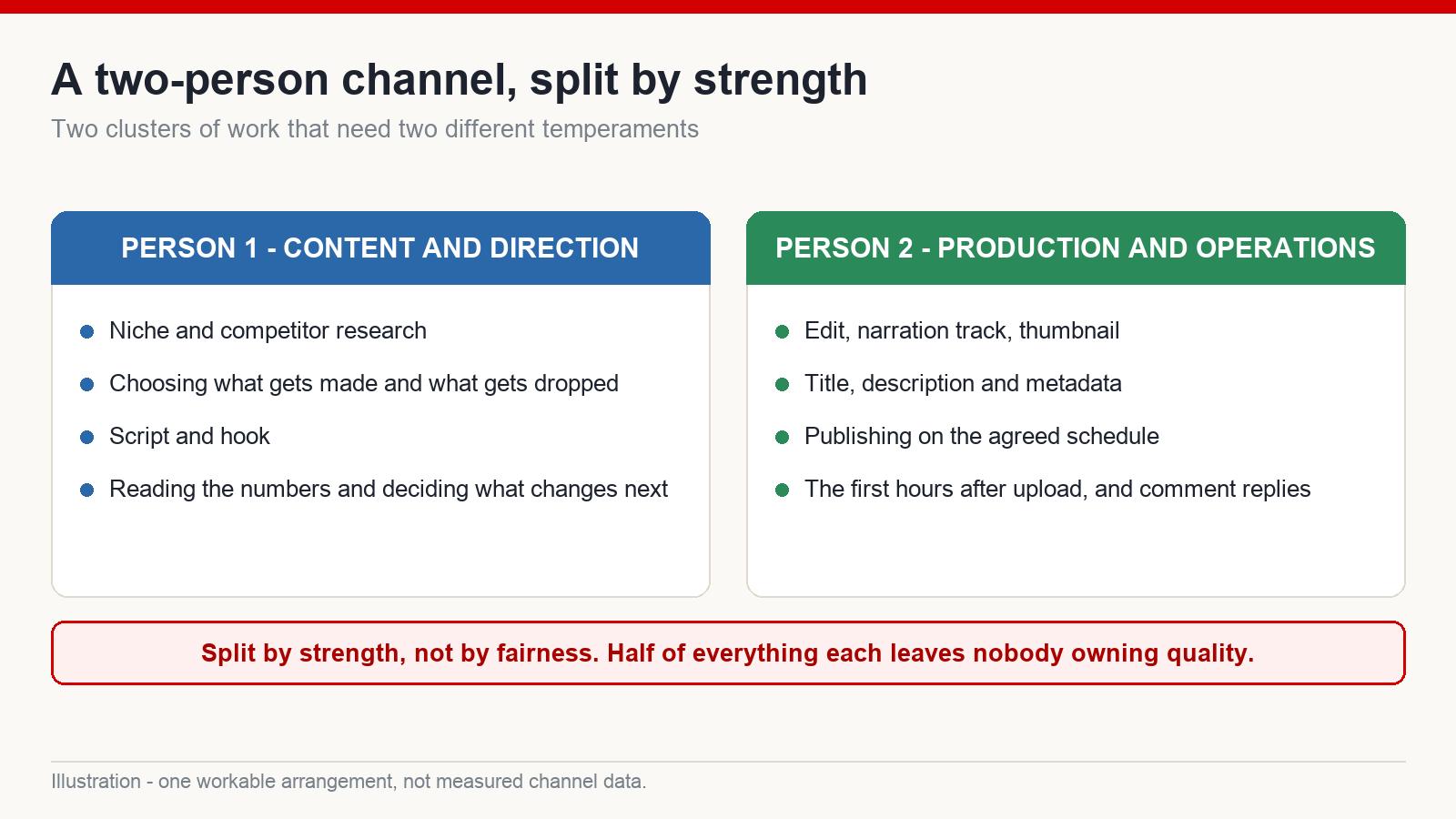
Once you accept that one person cannot run a channel indefinitely, the next question is what to do about it. For most creators the answer is not a team. It is a second person.
Two is the smallest arrangement that genuinely changes the shape of the work, and it is small enough that nobody has to manage anybody. But two people do not automatically go twice as fast. Split the work badly and you have doubled the confusion instead. Split it well and the difference is larger than the headcount suggests.
Why the work divides naturally in two
Look at everything a channel requires and it falls into two clusters that barely overlap.
One cluster is thinking: what the channel is about, who it is for, which topics get made, what the script argues, how the opening earns attention, what the numbers are saying about the direction. Open-ended work, done before anything exists.
The other is building and running: turning a finished script into a finished video, packaging it, putting it out on schedule, being present in the hours after upload, keeping the files and assets in order. Closed work, with a definition of done.
These want different temperaments. The first rewards someone who is comfortable sitting with an unformed idea. The second rewards someone who finishes things and does not need the work to be interesting to do it well. Asking one person to be both, all day, is exactly the problem you were trying to escape.
Split by strength, not by fairness
The most common mistake in a two-person setup is dividing the work to feel equitable: we will each do half the research, half the scripts, half the edits. It sounds reasonable and it is the worst arrangement available.
It guarantees that both of you spend half your time on the work you are worse at. It produces videos with two different voices inside them. And critically, it means nobody owns quality – when something goes out weak, the responsibility is smeared across both of you and nothing gets fixed.
Divide by strength instead. Each person spends the bulk of their time on the cluster that suits them, and each cluster has one name attached to it.
Person one: content and direction
This is the channel’s head. Niche and competitor research, deciding which topics get made and which get dropped, writing the script and the hook, reading performance data and turning it into a decision about what changes next.
The job is to know the audience well enough to answer the question the rest of the work depends on: what should we say, to whom, and why would they care more about our version than someone else’s. It requires actual curiosity – somebody who only writes to a brief handed to them will not do this well, because the brief is the hard part.
Person two: production and operations
This is the person who turns intent into a published video: the edit, the narration track, the thumbnail, the title and description, the upload on the day it was promised, presence in the comments in the first hours, and the unglamorous discipline of keeping footage, project files and scripts where they can be found.
This work rewards precision and consistency more than flair. Someone strong here is what keeps a channel publishing at all, because operational steadiness is usually the first thing a creative person quietly abandons.
Clear boundaries, one deliberate overlap
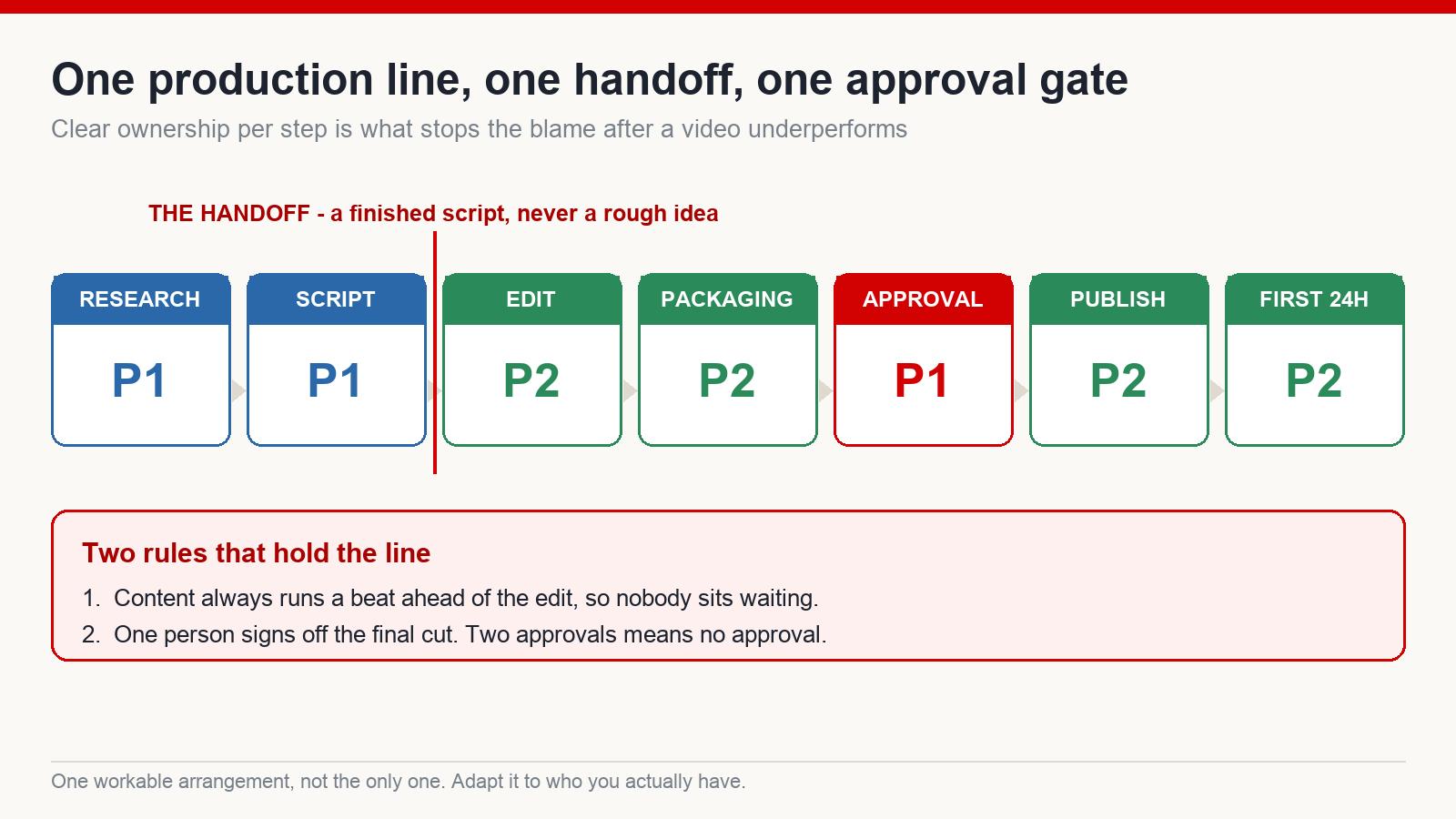
The boundaries exist so you do not step on each other. But one point of contact has to be explicit: who signs off the final cut.
Normally that is the content owner, because they hold the picture of what the channel is and what makes it consistent. Whoever it is, it must be one person. Two approvals means no approval – it means an argument at eleven at night, then publishing whatever was easiest.
Two other rules keep the line moving. First, content runs a beat ahead of the edit. The scripts should be finished before the editor needs them, or the editor sits idle and then rushes. Second, the handoff is a finished script, never a rough idea. Handing over half-formed material makes the other person guess, and their guesses will not match yours.
Alongside that, both of you should look at the numbers together on a regular cycle – fortnightly is enough for most channels. Not to assign blame, but because the person editing sees things the person writing does not, and the split otherwise turns into two people working on separate projects that happen to share a channel.
The failure modes to watch for
Two-person setups tend to break in predictable ways, and all of them are visible early.
Scope creep in silence. The editor starts choosing topics because the scripts are late. The writer starts re-cutting sections because they did not like a transition. Nobody says anything, and within a month both roles are mush again.
The editor waiting. If production regularly has nothing to build, the problem is upstream, and it will be misread as the editor being slow. Fix the script buffer before you question the person.
Blame after a flop. A video underperforms and the diagnosis becomes personal. With clear ownership per step you can actually locate it: a weak premise is a content question, a weak thumbnail is a packaging question, and they have different fixes.
No written process. Two people improvising in parallel is not a team. If the checklists do not exist, the second person is just a witness to your chaos.
Starting a two-person team without regretting it
Give it a defined trial. Agree on a small batch of videos – three or four – with a written brief for each, one review conversation per video, and an honest conversation at the end about what actually worked. That is long enough to see whether the split fits the two of you and short enough that neither party is trapped.
Expect the first videos to take longer than doing it alone. Handing work over always costs before it pays, and the payoff arrives when the other person stops asking you questions you have already answered – which is a function of how good your written process is, not how good they are.
Results vary, and some pairings simply do not fit. That is worth finding out over four videos rather than over a year.
Two people, one direction
An effective pair is not effective because there are more hands. It is effective because each person is doing the work they are actually suited to, inside a process clear enough that the handoff does not need a conversation every time.
That is the natural step after working alone stops paying. If you want a structured route through building that process before you add anyone to it, that is what we work on at mmoyoutube.com.